Languages

rhino

English

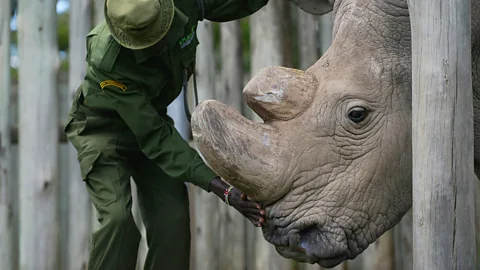
Last male of his kind: The rhino that became a conservation icon


Getty Images The last male northern white rhino Sudan at the Ol Pejeta conservancy Kenya (Getty Images)

Tony Karumba's photo of Sudan with his carer made the rhino a global sensation in his final year

Sudan, the world's last male northern white rhino, died in 2018. In his final years, he became a global celebrity and conservation icon, helping raise awareness about the brutality of poaching.

Vietnamese rhino horn traffickers charged in South Africa

Two Vietnamese nationals in South Africa have been charged with the illegal possession of 41kg (90lbs) of rhino horn, police have told the BBC. Officials say it is the largest amount of black market rhino horn to be seized in South Africa. The men, believed to be linked to an international poaching ring, had been under surveillance before their arrest at a Johannesburg airport, police say. Nearly 900 rhino have been killed in South Africa since January. Rhino horn can sell for up to $65,000 (£47,500) per kg - which is nearly double the price of gold - with China and Vietnam being the largest markets. Police say the illegal haul was found by a dog that specialises in sniffing out rhino horn at OR Tambo International Airport in Johannesburg on Sunday. 'National crisis' Paul Ramaloko, spokesperson for South Africa's organised crime fighting unit, told the BBC it was equivalent of 20 rhino horns with an estimated value of $358,000. Some South Africans have staged protests calling for more action against poaching. "Rhino poaching is regarded as a national crisis - for this reason those found guilty of the crime are dealt with harshly," he said. It is believed that the horns were most likely to have been removed from animals in South Africa's Kruger National Park, but tests need to be done to determine their origin, officials say.

Organised crime and Asian superstition driving rhinos and elephants to extinction

Ivory destruction Despite efforts to destroy ivory, criminals are becoming more organised, ingenious and dangerous. "We have seen more and more organised crime networks moving into the wildlife trade," says Davyth Stewart from Interpol, the international intelligence agency. "Groups who have been traditionally involved in drug trafficking, fire arms and human trafficking are now moving onto wildlife." It's clearly not a fair match: conservationists pitted against criminal gangs. But the wildlife experts say it's a fight they have to take on. They have gathered at the Zoological Society of London to tackle how to halt the rapidly growing trade in animals. The backdrop to these crisis talks is bleak. Thousands of rhinos, elephants, tigers and others have been slaughtered, becoming part of an illegal market that's worth an estimated $19bn a year. Many criminals see it as low risk, high profit, says Mr Stewart. "There is a lower risk of apprehension, it's unfortunate but law enforcement has not invested the resources in attacking wildlife crime as it has in other crimes," he explains. "Even in courts the penalties are much lower. Just last year in Ireland, we saw two people arrested for smuggling rhino horns worth half a million euros. They received a 500-euro fine." Demand and supply John Sellar, the former chief of enforcement at Cites (the Convention on International Trade in Endangered Species), says the focus of the battle should be shifted away from conservation towards the issue of criminality. "It's about locking up the bad guys," he tells the conference.

Rhino poaching driving black rhino and white rhino to near extinction

white rhinos
white rhinos kenya

Located 160km north of Nairobi, Solio Reserve is the premier place in Africa to see black and white rhino in the wild, but these precious animals are at the heart of a bloody poaching battle. The previous night, armed rangers who patrol the park’s 48km-long electric fence saw three men with tools and guns try to enter the reserve – and the previous month they discovered poachers cutting a hole in the fence near where a pair of cheetah makes their den. On both occasions, the rangers won out, but it was an unsettling reminder that the battle for the survival of one of Africa’s most endangered species is far from won. The problem is so rampant in central Kenya, where breeders have made in-roads into breeding rhinos in captivity on private reserves, that during the monthly full moon cycle, when poachers are not reliant on torches or headlamps for light, the rhinos need to be protected 24 hours a day. Tragically, in 2012 Solio lost at least 12 out of around 220. “Solio represents the heartbeat of rhino conservation in Kenya,” said Felix Patton, the reserve’s rhino monitoring coordinator. “Because of that, the poaching pressure is ever present – so there is a need to bring in more income to sustain the rhinos’ security and habitat. More importantly, though, we need to change the poacher’s attitudes – because the real value of rhino horn is completely misunderstood.

Rhino poaching in South Africa reaches record levels

Rhino poaching in South Africa reaches record levels

 
dead rhino
 
A dead rhino is dehorned by a researcher in Zimbabwe.
 

Figures from the South African government indicate that poaching for rhinoceros has increased substantially in the last year.

A record 668 rhinos were killed for their horns in 2012, up almost 50% on the number for 2011.

The majority of the animals were killed in the Kruger national park, the country's biggest wildlife reserve.


“Rhinos are being illegally killed...all for the frivolous


use of their horns as a hangover cure” Sabri Zain TRAFFIC


Experts say that growing demand for rhino horn in Asia is driving the slaughter.

South Africa is home to around three quarters of the world's rhinoceros

population of around 28,000 animals. In 2007 a mere 13 animals were lost to poachers.

But since then the killing has increased substantially. It is being fuelled

by the belief in countries like China and Vietnam that powdered rhino horn has

medicinal powers and can impact diseases like cancer. Horns can sell for around $65,000 a kg.

Poaching crisis

The rich rewards have attracted criminal gangs who deploy a range of

sophisticated technologies in their efforts to capture and dehorn the animals.

Rhinos and Elephants - largest land animals - endangered

Rhinos and elephants: the secret lives of Africa's giants

Rhinos and elephants have a range of remarkable behaviours and adaptations, many of which we are only just learning.

Emerging through the twilight, a beast lumbers forward, sniffing, snorting, searching for something.

One of the largest animals to walk the earth, it is on a surprising mission.

This black rhino is embarking on a midnight journey, seeking out other rhinos

in the dark to socialise and mate with, sharing some never-before-seen tender moments.
 
Because despite their size, we are only just beginning to notice some remarkable behaviours and adaptations of elephants and rhinos.

These two groups are the largest terrestrial animals.

The three species of elephant range from 5.5 tonnes for an average male African bush elephant to 2.7 tonnes for female Asian elephants. Rhinos, of which there are five species, can exceed 3.5 tonnes.

Their size makes them relatively easy to spot and an easy target for poachers, who continue to hunt both groups of large mammal in significant numbers: elephants mainly for ivory in their tusks and rhinos for their horns.

They have all been extensively studied by scientists, in the field and also in wildlife parks, breeding centres and zoos.

But much about them, and what they get up to, remains a mystery, with many discoveries into their behaviour and adaptations only being made recently.

Wildlife Crime Threatens Species and Nations

Wildlife crime profound threat to nations, says report

 
Tiger cub
 
A tiger cub rescued from smugglers in Thailand en route to China
 

The global illegal trade in wildlife

is worth $19bn (£12bn) a year and is threatening the stability of some

governments according to new research.

Carried out for conservation group WWF, a report highlights a "new wave" of

organised wildlife crime by armed groups operating across borders.

It says funds from trafficking are being used to finance civil conflicts.

The study comes as Malaysian officials captured about 20 tonnes of ivory in one of the

biggest seizures ever made.


“The bloody ivory trade has reached new heights of destruction and depravity in 2012”


Will Travers Born Free Foundation

According to Jim Leape, WWF International director

general, the report underlines the fact that wildlife crime has escalated

drastically over the past decade and now posed a greater threat than

ever.

Armed by ivory
Tiger testicle
 
A tiger testicle, described by   

the WWF as of dubious authenticity, on sale in Bangkok

Poaching kills rare one-horned rhino in Assam state, India

India probes attacks on rhinos in Assam state

Villagers look at a wounded one-horned rhinoceros that was shot and dehorned by poachers in Parku hills, near Kaziranga National Park, about 250 kilometers (156 miles) east of Gauhati, India, Wednesday, Sept. 26, 2012
 
There have been a number of attacks this week.


India's top federal investigation agency will probe a series of attacks on rare one-horned rhinos by suspected poachers in the flood-hit state of Assam, a senior minister has said.

Rhino Poaching is driving the rhinoceros to extinction.

South Africa troops tackle rhino poachers

Rhinos in a game park in South Africa Rhinos are killed for their horns in many parts of Africa
 

South Africa is to deploy hundreds of extra troops along its borders to help fight gangs smuggling rhino horns, the government has announced.

Justice Minister Jeff Radebe said four military companies would be sent to the borders with Zimbabwe, Swaziland and Lesotho.

Syndicates export the horns from Africa to parts of Asia and the Middle East.

In 2011, a record 450 rhinos were killed by poachers in South Africa, the Department of Environment Affairs says.

Mr Radebe said about 600 soldiers would join the fight against rhino poaching.

"The deployment includes army engineers who are conducting repairs and maintenance on the Zimbabwe-Mozambique border fence, which is approximately 140 kilometres (85 miles)," Mr Radebe said.

Last year troops were deployed along the Mozambican border, many of them inside the world-famous Kruger National Park where more than 200 rhinos were killed last year.

"Effective border management is part of the government crime prevention strategy, which assists to deal with cross-border crime syndicates and curb poaching," said Mr Radebe.