Languages

deforestation

English

Three years left to limit warming to 1.5C, leading scientists warn - 2025

The Earth could be doomed to breach the symbolic 1.5C warming limit in as little as three years at current levels of carbon dioxide emissions.

That's the stark warning from more than 60 of the world's leading climate scientists in the most up-to-date assessment of the state of global warming.

Nearly 200 countries agreed to try to limit global temperature rises to 1.5C above levels of the late 1800s in a landmark agreement in 2015, with the aim of avoiding some of the worst impacts of climate change.

But countries have continued to burn record amounts of coal, oil and gas and chop down carbon-rich forests - leaving that international goal in peril.

Climate change has already worsened many weather extremes - such as the UK's 40C heat in July 2022 - and has rapidly raised global sea levels, threatening coastal communities.

"Things are all moving in the wrong direction," said lead author Prof Piers Forster, director of the Priestley Centre for Climate Futures at the University of Leeds.

"We're seeing some unprecedented changes and we're also seeing the heating of the Earth and sea-level rise accelerating as well."

These changes "have been predicted for some time and we can directly place them back to the very high level of emissions", he added.

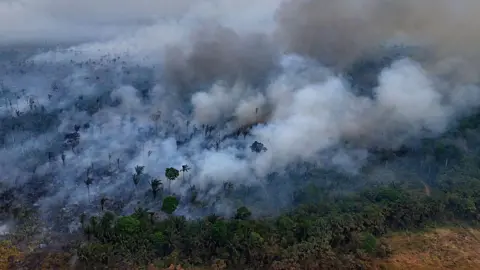
Tropical forests destroyed at fastest recorded rate in 2024


Getty Images Aerial shot of dense green rainforest with thick clouds of smoke rising up into the air

The world's tropical forests, which provide a crucial buffer against climate change, disappeared faster than ever recorded last year, new satellite analysis suggests.

Researchers estimate that 67,000 sq km (26,000 sq mi) of these pristine, old-growth forests were lost in 2024 – an area nearly as large as the Republic of Ireland, or 18 football pitches a minute.

Rubber plantations destroying biodiversity and forcing habitat loss for endangered birds, bats and primates in Southeast Asia

The global demand for rubber tyres is threatening protected forests in Southeast Asia, according to a study. Tropical forests are being cleared for rubber plantations, putting endangered birds, bats and primates at risk, say UK researchers. By 2024, up to 8.5 million hectares of new rubber plantations will be needed to meet demand, they report in Conservation Letters. This could have a "catastrophic" impact on wildlife, they warn. Species such as the endangered white-shouldered ibis, yellow-cheeked crested gibbon and clouded leopard could lose precious habitat, said the team led by Eleanor Warren-Thomas, from the School of Environmental Sciences at the University of East Anglia. Also, the banteng, which is found in the forests of Cambodia. There's a lot we can do as scientists and the public to make rubber production more wildlife-friendly. "The tyre industry consumes 70% of all natural rubber grown, and rising demand for vehicle and aeroplane tyres is behind the recent expansion of plantations. But the impact of this is a loss of tropical biodiversity," she said. "We predict that between 4.3 and 8.5 million hectares of new plantations will be required to meet projected demand by 2024. This will threaten significant areas of Asian forest, including many protected areas." Eight-point-five million hectares is about the size of the land area of Austria. Biodiversity concern Rubber is the most rapidly expanding tree crop within mainland Southeast Asia.

Indonesia surpasses Brazil in deforestation rate

deforestation-indonesia-2013.jpg
This photo taken on 13 November 2013 shows a timber company's vehicle driving down a dirt road in the forests of in Berau, East Kalimantan. Researcher say deforestation has led to an increase in greenhouse gas emissions and a loss of Indonesia's biodiversity.

A new study has shown that Indonesia lost about 60,000 sq km of virgin forest - an area close to the size of Ireland - over a period of 12 years.

The rate of deforestation has increased so much that Indonesia has for the first time surpassed Brazil in the rate of its clearance of tropical forests.

The study was published in the journal Nature Climate Change.

Scientists monitored the growth of deforested land in Indonesia between 2000 and 2012 using satellites.
indonesia-sattelite-image-riau-deforestation.jpg
Picture of Riau province's rate of deforestation. Satellite imagery of Indonesia's Riau province showed wetland forest loss (in red) and forest degradation (in blue) over the study period
They say the land was cleared to make way for palm oil plantations and other farms.

By 2012, the loss of primary forest every year in Indonesia was estimated to be higher than that in Brazil, said scientists.

In that year, Indonesia lost 8,400 sq km of forest compared to Brazil which lost 4,600 sq km.

Deforestation leaves fish undersized and underfed

mountain-lake-canada

The role forest matter plays in aquatic food chains is a relatively recent discovery.

Deforestation is reducing the amount of leaf litter falling into rivers and lakes, resulting in less food being available to fish, a study suggests.

Researchers found the amount of food available affected the size of young fish and influenced the number that went on to reach adulthood.

The team said the results illustrated a link between watershed protection and healthy freshwater fish populations.

The findings have been published in Nature Communications.

"We found fish that had almost 70% of their biomass made from carbon that came from trees and leaves instead of aquatic food chain sources," explained lead author Andrew Tanentzap from the University of Cambridge's Department of Plant Sciences.

"While plankton raised on algal carbon is more nutritious, organic carbon from trees washed into lakes is a hugely important food source for freshwater fish, bolstering their diet to ensure good size and strength," he added.

Dr Tanentzap observed: "Where you have more dissolved forest matter you have more bacteria, more bacteria equals more zooplankton.

"Areas with the most zooplankton had the largest, fattest fish," he added, referring to the study's results.

The team of scientists from Canada and the UK collected data from eight locations with varying levels of tree cover around Daisy Lake, Canada, which forms part of the boreal ecosystem.

Amazon and Global Deforestation rose in 2013

Brazil says Amazon deforestation rose 28% in a year

Brazil Environment minister Izabella Teixeira
Minister Izabella Teixeira says she will tackle the problem with local authorities.

Brazil says the rate of deforestation in the Amazon increased by 28% between August 2012 and last July, after years of decline. The government is working to reverse this "crime", Environment Minister Izabella Teixeira said. Activists have blamed the increase in destruction on a controversial reform to Brazil's forest protection law. Last year Brazil reported the lowest rate of deforestation in the Amazon since monitoring began. The provisional statistics from August 2012 to last July suggest that the area suffering deforestation was 5,843 sq km (2,255 sq miles), compared to 4,571 sq km (1,765 sq miles) in the previous 12 months. The 28% rise interrupts a period of declining deforestation which began in 2009. However, it still remains the second lowest annual figure for forest loss in absolute terms. The worst year on record was 2004, when 27,000 sq km of forest was destroyed. Monthly data from several scientific institutions had suggested the deforestation rate might be on the rise.

Just 227 tree species dominate Amazon - 11,000 endangered tree species

Just 227 tree species dominate Amazon

Researchers were surprised to find that such a small proportion of species dominated the Amazon .
Despite being home to about 16,000 tree species, just 227 "hyperdominant" species account for half of Amazonia's total trees, a study suggests.

An international team of researchers found that the region was, in total, home to an estimated 390 billion trees.

Writing in Science, they added that the rarest 11,000 species made up only 0.12% of tree cover.

However, they added that the new data could help unlock ecological secrets held by the biodiversity hotspot.

The results were based on a survey of 1,170 plots and half-a-million trees across the six-million-square-kilometre area, often described as the lungs of the world.

The authors said that the underlying cause of the hyper dominance of the 227 species, which accounted for 1.4% of the estimated number of species in the region, remained unknown.

"We knew that, normally, a few species dominate ecosystems, but if you have a system that has 16,000 tree species but just 227 make up half of the trees, that was pretty surprising even for us," said lead author Dr Hans ter Steege from the Naturalis Biodiversity Center in the Netherlands.

He told the Science podcast: "We don't really know why these species are so incredibly dominant because they do not have any particular ecological feature that stands out."

Conservation targets need billions in funding

Scientists say billions required to meet conservation targets

 
Ethiopian bush crow
 
The most threatened species tend to be relatively cheap to save because of small range sizes.
 

Reducing the risk of extinction for

threatened species and establishing protected areas for nature will cost the world over $76bn dollars annually.

Researchers say it is needed to meet globally agreed conservation targets by 2020.

The scientists say the daunting number is just a fifth of what the world spends on soft drinks annually.

And it amounts to just 1% of the value of ecosystems being lost every year, they report in the journal Science.

“Nature just doesn't do recessions, we're talking about the irreversible loss of unique species and millions of years of evolutionary history”

Donal McCarthy RSPB

Back in 2002, governments around the world agreed that they would achieve a significant reduction in biodiversity loss by 2010. But the deadline came and went and the rate of loss increased.

At a meeting of the Convention on Biological Diversity in Nagoya that year governments re-committed to a series of targets to be achieved by 2020.

Global alliance aims to tackle forest crime - illegal logging and timber trafficking

Global alliance aims to tackle forest crime

 AP)
 
Illegal logging damages biodiversity and undermines people's livelihoods.
 

Interpol and the United Nations have joined forces to launch an initiative to tackle global forest crime.

Project Leaf will target criminals involved in illegal logging and timber trafficking.

The scheme will also provide support to enforcement agencies in countries

with the biggest problems, Interpol said.

It is estimated that more than a quarter of the world's population relies on

forests for their livelihoods, fuel, food and medicines.

David Higgins, Interpol's Environmental Crime Programme manager, said that

illegal logging was no longer a issue that was restricted by national

boundaries.

"The international legislation to protect forests and curtail illegal logging

demonstrates this," he commented.

"Project leaf will ensure these global laws are supported by global

enforcement and that the criminals responsible are brought to justice - no

matter their location, movements or resources."

Project leaf (Law Enforcement Assistance for Forests) is a partnership

between the UN Environment Programme (Unep) and Interpol, with funding provided

by the Norwegian Agency for Development Cooperation.

Brazils Congress approves controversial forest law

 
A\member of Congress protests as the Chamber of Deputies holds a plenary vote on the forest code 25 April 2012
 
Wednesday's vote capped months  

of bitter political argument


The Brazilian Chamber of Deputies has

approved controversial legislation that eases rules on how much land farmers

must preserve as forest.

Brazil's powerful farmers' lobby argues that the changes will promote

sustainable food production.

But environmentalists say the new forest code will be a disaster and lead to

further destruction of the Amazon.

The bill now goes to President Dilma Rousseff, who may use her veto to remove

some clauses.

Wednesday's 247-184 vote in favour of the new forest code capped a year of

political wrangling.

Brazil's farmers have long pushed for changes, arguing that uncertainty over

the current legislation has undermined investment in the agriculture sector,

which accounts for more than 5% of GDP.

Pages